




Injection Molding Instabilities – Originating During Plasticizing
How Melt Rheology, Plasticizing Conditions and Polymer Degradation Influence Part Quality
Learn how melt rheology, plasticizing conditions, melt homogeneity, residence time and polymer degradation influence injection molding stability and part quality.
Introduction
Injection molding is a complex interaction between polymer behaviour, machine design, mold geometry and process conditions. Attention is often concentrated on cavity filling, mold temperature control or injection speed. However, a significant proportion of process instabilities may originate before injection begins, while the material is being melted, conveyed and homogenised inside the injection unit.
The melt entering the mold carries the complete thermal and mechanical history of plasticizing. If this history varies from cycle to cycle, the rheological condition of the melt also varies. The resulting differences may appear as streaks, changes in colour or gloss, dimensional variation, unstable filling or deterioration of mechanical properties.
Understanding plasticizing is therefore essential for reliable troubleshooting. The objective is not merely to adjust barrel temperatures, screw speed or back pressure, but to understand how these parameters interact and how they influence the actual condition of the polymer melt.
Rheological Properties of Polymer Melts
Polymer melts are non-Newtonian and viscoelastic fluids. Their apparent viscosity depends on temperature, shear rate and pressure, while their elastic response originates from the long-chain molecular structure of polymers. These characteristics govern the way the melt flows through the plasticizing unit, runner system, gate and mold cavity.
As shear rate increases, the apparent viscosity of most polymer melts decreases. This shear-thinning behaviour enables the material to fill thin sections and complex geometries. At the same time, high shear conditions increase mechanical energy input. Part of this energy is converted into heat through energy dissipation, which may locally raise the melt temperature.
The effect of pressure should also be considered. Increasing pressure may increase melt viscosity, particularly at the high pressure levels encountered during injection. The actual flow behaviour therefore results from the combined influence of temperature, shear rate and pressure rather than from any single parameter.
From an engineering perspective, rheology is not an isolated material property. It is the link between material condition, machine settings, flow resistance and cavity filling. Understanding this relationship is essential when evaluating pressure losses, filling stability and the risk of local overheating or degradation.
Fountain Flow and Surface Defects
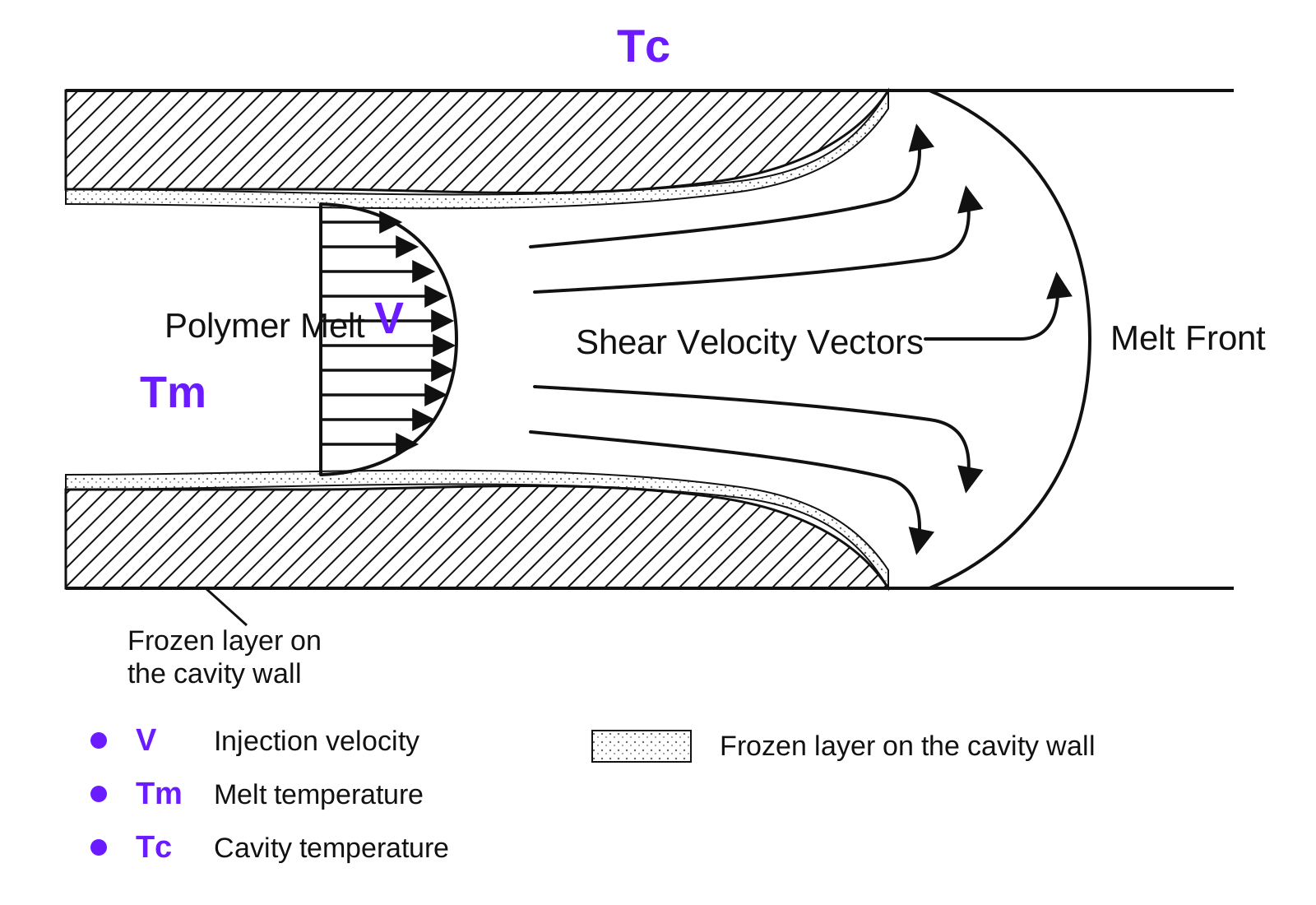
When the polymer melt enters a colder mold cavity, material in contact with the cavity wall begins to cool and forms a frozen layer. The still-flowing melt continues through the hotter central region. Near the flow front, material from the centre is redirected outward towards the cavity wall, where it forms the surface layer of the part. This characteristic mechanism is known as fountain flow.
Fountain flow has an important influence on surface quality and molecular orientation. Material elements travelling through the central flow region may eventually reach the visible surface of the molded part. If the melt contains degraded particles, unmelted material, fibres, contaminants or other inhomogeneities, the fountain-flow mechanism may transport them to the surface and make them visible as streaks or local surface variation.
The visible location of a defect therefore does not necessarily identify the location where it originated. A surface streak observed downstream in the cavity may have been created during plasticizing, in a stagnant region of the plasticizing unit or at a geometrical transition before the melt entered the runner system.
Melt Temperature: Actual Condition versus Machine Setting
The temperatures displayed on the injection molding machine represent the control temperatures of the barrel heating zones. They do not directly represent the temperature of the polymer melt. During plasticizing, the material receives energy from both external heating and mechanical work generated by screw rotation, compression, friction and shear.
Depending on the material, screw design and operating conditions, energy dissipation may significantly increase the actual melt temperature. Consequently, two processes with identical barrel settings may produce melts with different thermal conditions if screw speed, back pressure, shot size or cycle time differ.
The melt may also be thermally non-uniform. Local temperature differences can remain within the melt even when the average temperature appears acceptable. These differences influence viscosity, filling behaviour and the susceptibility of the polymer to degradation.
For process optimisation, heater control temperatures should therefore be treated as machine inputs rather than direct evidence of melt condition. Direct or indirect measurement of actual melt temperature provides a more reliable basis for understanding process behaviour.
Residence Time
Residence time is the period for which the polymer remains at processing temperature inside the plasticizing unit and, where applicable, the heated runner system. It determines the duration of thermal exposure before the material enters the mold cavity.
Excessive residence time increases the probability of thermal and oxidative degradation. The risk depends on the polymer, its additives, processing temperature and stabilisation system. Fillers, flame retardants, colourants or repeated thermal history may further reduce the processing tolerance of the material.
Residence time is influenced by the relationship between barrel capacity, shot volume and cycle time. A small shot processed in an oversized plasticizing unit may remain in the barrel for many cycles. Stagnant regions, leakage across a worn non-return valve or material retained in dead zones can extend the residence time of only part of the melt, creating intermittent defects that are difficult to reproduce.
The relevant question is therefore not only the average residence time, but also whether all material follows a comparable thermal history. Experimental tracing methods and calculations based on machine and cycle data can both support this assessment.
Melt Homogeneity
The purpose of plasticizing is to produce a melt with sufficiently uniform temperature, composition and rheological behaviour. A homogeneous melt supports stable filling and repeatable part quality. An inhomogeneous melt contains local regions with different viscosity, temperature, degree of melting or material composition.
Insufficient melting may leave unmelted or partially melted particles in the melt. Poor mixing may produce uneven distribution of colourants, additives, fibres or regrind. Local overheating may create degraded material with a different molecular structure and rheological response. These inhomogeneities may subsequently appear as light streaks, dark streaks, colour variation or other surface defects.
Melt homogeneity is strongly influenced by barrel temperature profile, screw geometry, screw rotational speed, back pressure, shot size and residence time. Increasing mechanical work may improve melting and mixing, but excessive mechanical loading may also raise melt temperature and accelerate degradation. The objective is therefore to identify a stable processing window between insufficient homogenisation and excessive thermo-mechanical loading.
Polymer Degradation
Polymer degradation is one of the most significant factors affecting both process stability and the performance of injection molded parts. Unlike many processing variations, degradation is irreversible. Once polymer chains have been chemically altered, their original molecular structure and properties cannot be restored.
Degradation during injection molding is rarely caused by a single factor. It commonly results from the combined effects of elevated temperature, mechanical loading, oxygen exposure and excessive residence time. Thermal degradation may involve chain scission, oxidation or cross-linking. Mechanical degradation may originate from excessive shear stress, particularly when high shear is combined with elevated melt temperature.
These mechanisms reinforce one another. Elevated temperature accelerates chemical reactions, prolonged residence time extends the duration of exposure, and high shear conditions generate additional heat through energy dissipation. The final condition of the polymer therefore reflects its complete thermal and mechanical history.

Depending on material and processing conditions, degradation-related inhomogeneities may appear as dark streaks, black specks, colour streaks or local deterioration of surface quality. The same degradation may also reduce impact strength, increase brittleness or alter other part properties even when no visible defect is present.

Additional Sources of Degradation and Inhomogeneity
The design and condition of the plasticizing unit can create local sources of degradation. Worn non-return-valve components may allow part of the melt to move backwards instead of being injected, extending its residence time. Dead zones may retain material over multiple cycles, where it overheats and later contaminates otherwise acceptable melt.
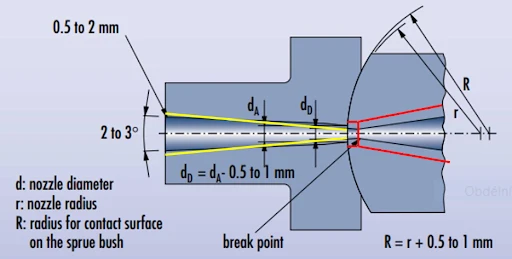
The transition between the machine nozzle and the sprue bushing should also be evaluated. A mismatch in diameters or an abrupt edge may create high local shear stress. Under critical conditions, this may damage polymer chains or separate pigments and additives, producing streaks downstream.
Material preparation is another important factor. Insufficient drying of hygroscopic polymers may cause hydrolytic degradation, whereas excessive drying temperature or unnecessarily long drying can damage certain materials or additive systems. Regrind introduces an additional thermal and mechanical history and may be distributed unevenly if mixing performance is insufficient.
Production interruptions also require controlled procedures. Polymer remaining in a heated barrel continues to experience thermal exposure during a stoppage. Appropriate purging, temperature reduction or material-specific shutdown procedures are therefore necessary before production resumes.
Plasticizing Unit Settings
The plasticizing unit should be treated as an interconnected processing system. Screw rotational speed, back pressure, barrel temperature profile, shot size, decompression and residence time influence one another and should not be optimised independently.
Increasing screw rotational speed reduces plasticizing time and may improve melting, but it also increases shear rate and mechanical energy input. Excessive speed may therefore increase melt temperature and degradation risk. Increasing back pressure can improve mixing and thermal uniformity, but also increases mechanical loading and energy dissipation.
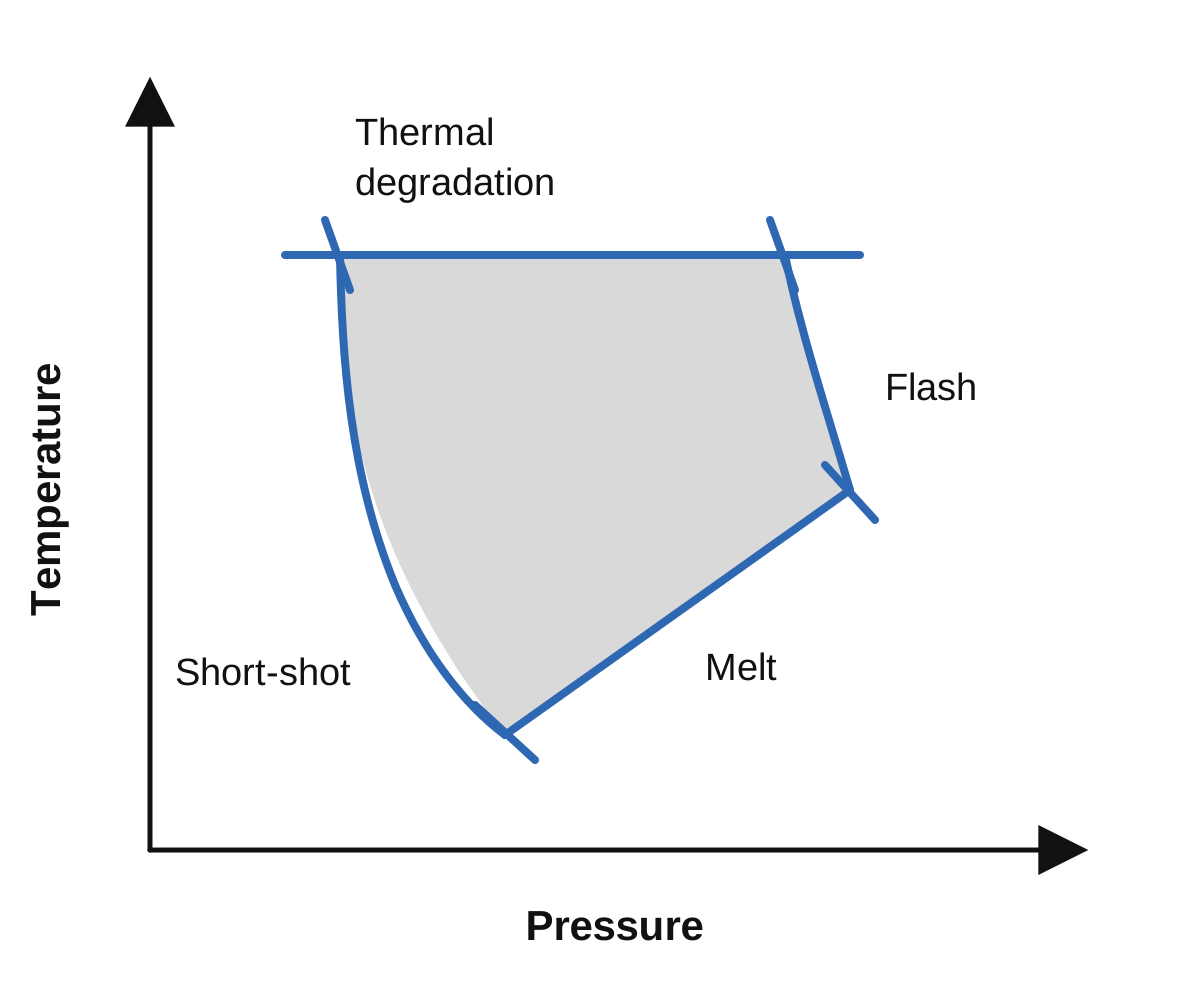
Very low screw speed or back pressure may leave the melt insufficiently homogenised. Excessively high values may move the process towards thermal or thermo-mechanical degradation. A useful engineering approach is to establish a processing window that separates these limiting conditions and identifies the range in which melt quality remains stable.
The objective of plasticizing is not to maximise screw speed or minimise recovery time in isolation. It is to produce a homogeneous melt with stable rheological properties while keeping the material within an acceptable processing window.
Measuring Melt Temperature and Cavity Pressure
Reliable process control requires information that represents the actual condition of the polymer. Barrel thermocouples primarily measure the thermal condition of the barrel rather than the bulk melt. Actual melt temperature can be assessed using suitable methods such as a probe in a purged shot, a sensor in the nozzle or specialised infrared measurement equipment.
Each method has limitations. A measurement should therefore be interpreted with knowledge of sensor location, response time, material emissivity and the degree to which the sample may cool during measurement. The objective is not a single absolute number without context, but a repeatable measurement that supports comparison and process understanding.
Cavity pressure provides information that machine hydraulic or injection pressure cannot fully replace. Sensors positioned in the mold record the pressure experienced by the polymer during filling, packing and cooling. Direct cavity-pressure sensors measure at the cavity surface, while indirect force sensors may obtain information through an ejector pin or another transmitting element.
Temperature and pressure measurements are most valuable when evaluated together. Melt temperature influences viscosity; cavity pressure reflects flow resistance and packing behaviour. Their combined interpretation helps distinguish between changes in material condition, machine performance and mold behaviour.
Shear Loading at the Gate and the Injection Process Window
The melt may leave the plasticizing unit in an acceptable condition and still experience critical shear loading at a restrictive gate or abrupt flow transition. Injection speed influences both the shear rate and pressure required to fill the cavity. At very low speed, the flow front may cool excessively and produce surface wrinkling or unstable advancement. At excessive speed, local shear stress and energy input may increase the risk of degradation or dark streaks.

The relevant processing window is therefore not defined by injection speed alone. It is the range in which the cavity fills reliably with acceptable pressure, without excessive cooling at the lower limit or damaging shear conditions at the upper limit. The geometry, wall thickness, flow length and material rheology all influence the boundaries of this window.
Moldflow Simulation and Process Understanding
Simulation is an important engineering tool for predicting filling patterns, pressure losses, shear-rate distribution, temperature fields and other aspects of the injection molding process. It can support gate design, part optimisation, mold development and process definition before physical trials begin.
Simulation should not be regarded as a substitute for engineering judgement. Every model is an approximation of physical reality, and predictive accuracy depends on mesh quality, material data, boundary conditions and the assumptions used to represent the real process.
Material data are generally obtained under controlled conditions. The actual production melt may differ because of temperature variation, residence time, degradation, moisture, regrind or insufficient homogeneity. If the material entering the mold does not match the condition assumed in the simulation, differences between predicted and measured behaviour should be expected.
Reliable engineering methodology therefore combines simulation with material knowledge, process measurements and practical understanding. When interpreted in this context, Moldflow becomes more than a predictive tool: it supports explanation, comparison of alternatives and informed decision-making throughout development and production.
Practical Engineering Recommendations
- Treat plasticizing as a critical stage of the injection molding process rather than as a preparatory operation.
- Evaluate melt quality and thermal history instead of relying solely on machine settings.
- Assess barrel temperature, screw rotational speed, back pressure, shot size and residence time as an interconnected system.
- Verify that machine size and shot volume provide an appropriate operating range.
- Check the condition of the non-return valve and identify possible dead zones or stagnant material.
- Control material drying, regrind content and additive distribution according to the polymer and part requirements.
- Evaluate nozzle-to-sprue transitions and gate geometry for excessive local shear loading.
- Use suitable melt-temperature and cavity-pressure measurements to validate process assumptions.
- Interpret Moldflow results in the context of the actual condition of the processed material.
- Identify the physical origin of instability instead of compensating for symptoms through isolated parameter changes.
Conclusion
Many injection molding defects become visible only after the polymer enters the mold cavity. Their origin, however, often lies much earlier in the process, during plasticizing and melt preparation.
Melt rheology, temperature, residence time, homogeneity and degradation are closely interconnected phenomena. None should be evaluated in isolation. Together they define the condition of the polymer melt that governs cavity filling, molecular orientation and the quality of the finished part.
Understanding these relationships enables engineers to move beyond trial-and-error adjustment. Instead of responding to individual defects after they occur, they can identify the underlying physical causes and optimise the process on the basis of measurable engineering principles.
Injection molding is not merely a sequence of machine operations. It is a complex interaction between material behaviour, machine design, mold geometry and process conditions. Sustainable improvements therefore require an understanding of the complete process rather than isolated optimisation of individual parameters.
Related webinar
1 – Injection instability – Rheology, plasticization, homogeneity, degradation, streaks
Related services
Frequently asked questions
Why can injection molding defects originate before the polymer enters the mold cavity?
Many defects are caused by changes in melt condition during plasticizing. Variations in temperature, residence time, homogenisation or degradation influence the behaviour of the melt during filling and may later appear as surface defects or property variation.
Is the barrel temperature displayed by the machine equal to the actual melt temperature?
No. The displayed values represent the control temperatures of the heating zones. Actual melt temperature results from both external heating and internally generated heat caused by mechanical work and energy dissipation.
Why is residence time important?
Residence time determines how long the polymer remains exposed to processing temperature. Excessive or non-uniform residence time increases the probability of thermal and oxidative degradation.
Why do defects sometimes appear only intermittently?
Intermittent defects may originate from material retained in dead zones, leakage across a worn non-return valve, fluctuating residence time, uneven regrind distribution or periodic release of degraded material.
Why is melt homogeneity important?
A homogeneous melt has more uniform temperature, viscosity and composition. Local inhomogeneities can disturb filling and appear as light streaks, dark streaks, colour variation or other surface defects.
Can increasing screw speed improve productivity without affecting melt quality?
Not necessarily. Higher screw speed reduces recovery time but increases shear rate and mechanical energy input. Under some conditions this may raise melt temperature and degradation risk.
Does higher back pressure always improve homogenisation?
No. Back pressure can improve mixing, but excessive values increase mechanical loading, recovery time and energy dissipation. The appropriate setting depends on the material, screw design and required melt quality.
How can degradation be distinguished from insufficient homogenisation?
Dark streaks or black specks may indicate degraded material, while light streaks may be associated with unmelted particles or insufficient homogenisation. However, visual appearance alone is not conclusive; the process history and material condition should also be evaluated.
Why should melt temperature and cavity pressure be measured together?
Melt temperature influences viscosity, while cavity pressure reflects the resistance and packing behaviour experienced inside the mold. Together they provide a more complete picture of the process.
Does Moldflow always reproduce production behaviour accurately?
Simulation accuracy depends on input data and engineering assumptions. If the actual material condition, temperature, machine behaviour or boundary conditions differ from the model, discrepancies should be expected.
Is process optimisation primarily about adjusting machine settings?
No. Machine settings are control inputs. Effective optimisation begins by identifying the physical mechanism responsible for instability and then selecting settings that keep the material and process within a stable operating window.